Make Enterprise AI DPDP-Compliant
At the Infrastructure Layer
DPDP doesn't tell you to stop using AI. It tells you to prove you're using it safely. Mavs AI is how you prove it, across every prompt, app, and agent.



DPDP Gives You Five Duties
AI Puts Every One of Them at Risk

01 — Document what you collect and why.
₹50 cr max penaltyEvery piece of personal data you collect needs a documented reason, a clear notice to the person it belongs to (called a Data Principal), and proof of consent. Records of processing (RoPA), impact assessments for risk (DPIA), and vendor processor agreements (DPAs) have to be current at all times. Risk: Employees pasting customer data into third-party LLMs break the notice the Data Principal consented to. When a vendor does the same, you stay liable, irrespective of what the DPA says.
02 — Demonstrate technical safeguards on personal data.
₹250 cr max penaltyPersonal data must be protected by basic security controls: encryption, access control, logging, monitoring, and retention limits. These safeguards must be demonstrable to the regulator. Risk: Sending unmasked PII to an LLM fails this twice. The data leaves unencrypted, then sits in vector databases, caches, and vendor logs outside your control.
03 — Honour data principal rights.
₹50 cr max penaltyEvery Data Principal can ask you to show, correct, or erase the personal data you hold about them. They can also withdraw consent or file a grievance. Each request comes with a defined turnaround time, and any failure can be reported to the regulator (the Data Protection Board, or DPB). Risk: Once personal data reaches a third party LLM, it sits in chat history, vector indices, and vendor logs you do not control. You cannot pull it back, and thus you cannot honour a Data Principal's access, correction, or erasure request.
04 — Respond to breaches inside the clock.
₹200 cr max penaltyIf personal data is breached, you must notify the affected Data Principals immediately and the Data Protection Board within 72 hours. The notification has to cover scope, root cause backed by logs and access records, and remediation. Risk: AI prompts leave no native audit trail. Without per-prompt logs, you cannot identify which Data Principals were exposed or what data left your perimeter.
05 — Prove your algorithmic processing is safe.
₹150 cr max penaltyIf your business processes a large volume of personal data, the government may classify it as a Significant Data Fiduciary (SDF). That brings an extra obligation: algorithmic due diligence and an annual independent audit of your AI systems. Risk: An audit demands three proofs: that your AI never received unmasked PII, that you have safeguards against adversarial attacks that could leak data, and that you can honour Data Principal rights like erasure and correction. Without instrumentation between every prompt and every response, you have none of them.
Traditional Security Tools
Can't See AI-Based Violations
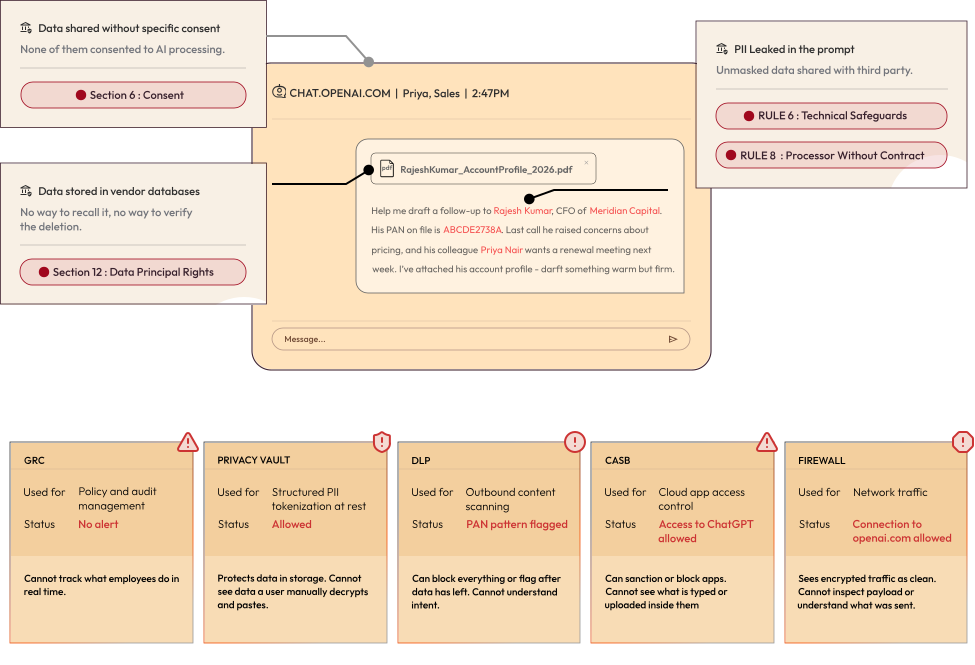
Scenario 1: An employee types into a chat app.
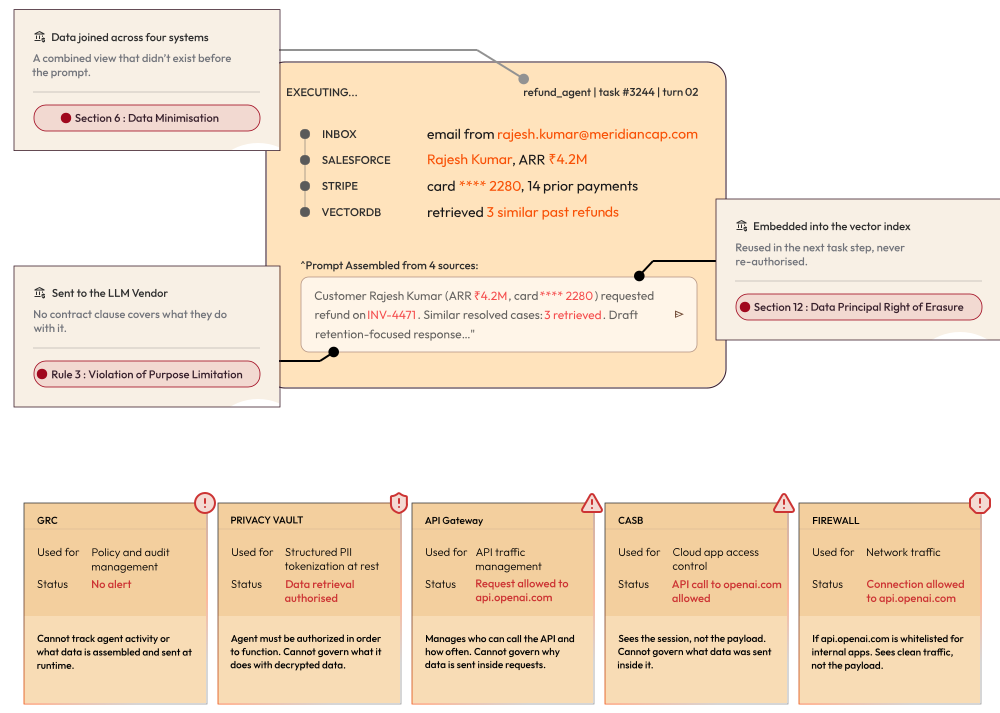
Scenario 2: An agent assembles a prompt from tools.

Three Pillars of the Mavs AI Control Layer for DPDP Compliance
DATA PROTECTION
AT THE PROMPT BOUNDARY
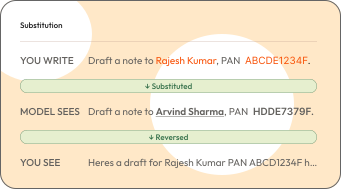
Mavs' Privacy-Enhancing Technology (PET) replaces personal data with synthetic equivalents that the model cannot distinguish from real data. Output quality holds. Your data never reaches the vendor.
CENTRALISED
ACCESS CONTROL
AND VISIBILITY
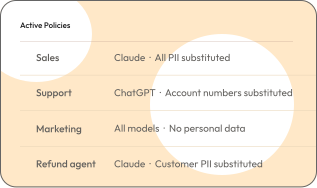
One control model, visible to the regulator. Set policies by user, by data category, in real time, revoke access in one click.
PER-PROMPT
AUDIT TRAIL
RETAINED FOR ONE YEAR
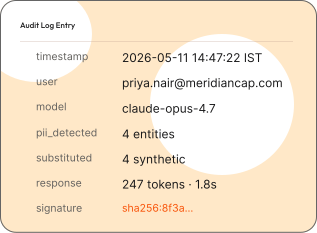
Every prompt, every substitution, every response logged immutably for one year. Breach reconstruction is instant. No waiting for vendor logs you don't control.
DPDP Is About Being Able to Prove Safety
Mavs AI enables you to do that without compromising on AI quality
| DPDP requirement | SASE AI guardrails | Independent AI guardrails | Mavs AI |
|---|---|---|---|
Technical safeguards for personal data protection |  Redacts data, loses context in prompts. Redacts data, loses context in prompts. | Masks or tokenizes data, degrades context in prompts. |  Synthetic data substitution in prompts for context-rich output. Synthetic data substitution in prompts for context-rich output. |
Safe enterprise AI usage | Blocks sensitive prompts. | Blocks sensitive prompts. | Synthetic data allows prompts to be processed. |
Audit evidence per processing event | Generic enterprise logging. |  Retention and granularity vary by provider. Retention and granularity vary by provider. | Per-entity log linking each personal data element to its substitution. Built for DPDP retention. |
Third-party processor scope | LLM provider remains in scope as a processor of personal data. | LLM provider processes only masked data. | LLM provider processes only synthetic data. Out of scope as a processor of personal data. |
Algorithmic due diligence | Denial layer, not a safeguard. | Safeguard layer, but loses context. | Safeguard layer. Personal data stays out of model processing. |
DPDP-native DPA | GDPR-derived with DPDP addendum. | DPDP coverage. | Indian entity. DPDP-native from day one. |
| DPDP requirement | Mavs AI | SASE AI guardrails | Independent AI guardrails |
|---|---|---|---|
Technical safeguards for personal data protection | Synthetic data substitution in prompts for context-rich output. | Redacts data, loses context in prompts. | Masks or tokenizes data, degrades context in prompts. |
Safe enterprise AI usage | Synthetic data allows prompts to be processed. | Blocks sensitive prompts. | Blocks sensitive prompts. |
Audit evidence per processing event | Per-entity log linking each personal data element to its substitution. Built for DPDP retention. | Generic enterprise logging. | Retention and granularity vary by provider. |
Third-party processor scope | LLM provider processes only synthetic data. Out of scope as a processor of personal data. | LLM provider remains in scope as a processor of personal data. | LLM provider processes only masked data. |
Algorithmic due diligence | Safeguard layer. Personal data stays out of model processing. | Denial layer, not a safeguard. | Safeguard layer, but loses context. |
DPDP-native DPA | Indian entity. DPDP-native from day one. | GDPR-derived with DPDP addendum. | DPDP coverage. |


'%3e%3cg%20filter='url(%23filter0_f_1862_1962)'%3e%3ccircle%20cx='376.5'%20cy='376.5'%20r='220.5'%20fill='%23FF6B00'/%3e%3c/g%3e%3c/g%3e%3cdefs%3e%3cfilter%20id='filter0_f_1862_1962'%20x='-44'%20y='-44'%20width='841'%20height='841'%20filterUnits='userSpaceOnUse'%20color-interpolation-filters='sRGB'%3e%3cfeFlood%20flood-opacity='0'%20result='BackgroundImageFix'/%3e%3cfeBlend%20mode='normal'%20in='SourceGraphic'%20in2='BackgroundImageFix'%20result='shape'/%3e%3cfeGaussianBlur%20stdDeviation='100'%20result='effect1_foregroundBlur_1862_1962'/%3e%3c/filter%3e%3cclipPath%20id='clip0_1862_1962'%3e%3crect%20width='754'%20height='754'%20fill='white'/%3e%3c/clipPath%3e%3c/defs%3e%3c/svg%3e)



Indian Personal Data We Protect in AI Prompts
Government IDs
- Aadhaar card number
- Aadhaar Virtual ID
- PAN card (Permanent Account Number)
- Voter ID card (EPIC number)
- Passport number
- Driving licence
- Vehicle registration number
Financial
- Bank account number
- UPI (Unified Payments Interface) ID
- Credit and debit card numbers
- Demat account number
- Loan account numbers
- CKYC (Central Know Your Customer) number
- NPS PRAN (Permanent Retirement Account Number)
Contact and identity
- Full names, including transliterated spellings
- Addresses and PIN codes
- Mobile numbers
- Email addresses
- IP addresses
- Device IDs, including IMEI numbers
Health, work and property
- ABHA (Ayushman Bharat Health Account) number
- UHID and hospital patient IDs
- Health insurance policy numbers
- Employee IDs
- UAN (Universal Account Number)
- Property and land record numbers
Frequently Asked Questions
When does DPDP enforcement begin?
DPDP enforcement is phased. The Data Protection Board was constituted on 13 November 2025. The Consent Manager regime activates 13 November 2026. Substantive duties (security safeguards, data principal rights, breach notification, algorithmic diligence) enforce from 13 May 2027.
Am I a Data Fiduciary or Significant Data Fiduciary under DPDP?
You're a Data Fiduciary if your business determines the purpose and means of processing personal data of Indian residents, regardless of business location. A Significant Data Fiduciary (SDF) is notified by the Central Government based on data volume, sensitivity, and risk to Data Principals. No SDFs notified yet. Banks, healthcare providers, and major internet platforms are widely expected to be first.
What does algorithmic risk assessment for SDFs involve?
Rule 13(3) requires SDFs to verify that their AI systems (including algorithmic software) are not likely to threaten Data Principal rights. In practice this means demonstrable safeguards against prompt injection and adversarial attacks, data leakage protection, and proof that access, correction, and erasure rights can still be honoured across the AI surface.
Is pasting customer data into ChatGPT a DPDP violation?
Usually yes. On the free tier, yes. There's no data processing agreement with OpenAI, no consent from the customer for AI processing, and no technical safeguards on the data being pasted. That fails Section 6, Section 8(2), and Section 8(5) simultaneously. Enterprise ChatGPT with a DPA closes the processor-contract gap, but it still isn't safe. Once unmasked customer data has been pasted into an LLM, you can't reliably honour a Data Principal's right to erasure under Section 12. The data may persist in vendor logs, caches, or model context you don't control. The only clean answer is to keep personal data out of the LLM in the first place.
Does using a foreign LLM count as cross-border transfer under Section 16?
Yes, if the prompt contains personal data. Section 16 permits cross-border transfer except to countries on a government-notified negative list. Even where permitted, sector restrictions apply (RBI for banking data, MeitY for sensitive personal data), with auditing obligations that don't apply in-country.
How is Mavs AI different from existing privacy or AI security tools?
Existing tools weren't built for the AI prompt layer. Privacy GRC platforms track policies and produce compliance reports, but they don't act on a live prompt. Privacy vaults tokenize data at rest, but by the time a prompt is being assembled, that data is already decrypted. Most AI gateways use regex pattern matching: they can detect sensitive content and block the prompt, but they can't safely let it through. Mavs AI operates at the prompt level. It understands the context and meaning of each prompt, accurately transforms personal data into synthetic equivalents, and lets the prompt continue to the LLM. Productive output, with your data never reaching third-party LLMs.
Does Mavs AI fulfill the Section 8(5) and Rule 6 technical safeguards requirement?
Yes. Rule 6 enumerates the safeguards: masking or encryption, access control, logging and monitoring with one-year retention, continuity, and a cascade to processors. Mavs AI implements each for AI surfaces: synthetic substitution at the prompt boundary, role-based access, immutable per-prompt audit trails, processor cascade. Each safeguard maps to its Rule 6 provision in the DPA.
Where and how does Mavs AI deploy?
Mavs is a runtime control layer over API. It deploys in the cloud or within your own environment, on-premises or in your VPC, and the original data and the substitution mapping stay inside your environment either way, which meets the Section 16 cross-border obligation by design. For employees, Mavs Secure Chat runs in the browser with nothing to install, and sign-in goes through your existing identity provider. For apps and agents, integration is via API. Most enterprises are live within a few hours.
Does Mavs AI sign a DPDP-ready Data Processing Agreement?
Yes. A standard DPA is available at procurement. It documents Section 8(2) processor safeguards, Rule 7 breach cooperation, sub-processor controls, and confirms Mavs does not train on customer data.